


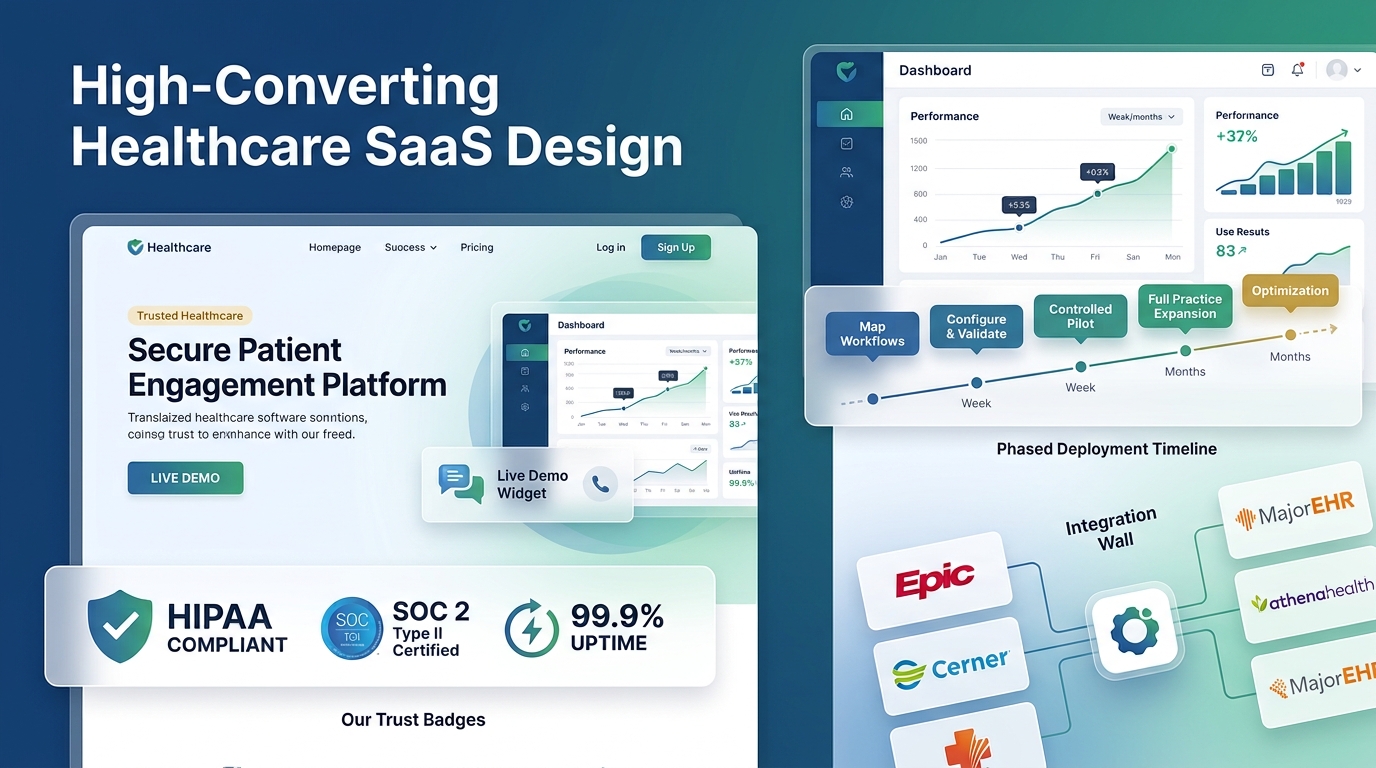
Selling software to a medical practice is selling to the most risk-aware buyer on the internet. The person evaluating the site is thinking about patient data, regulators, and what happens to their job if the vendor fails. A healthcare SaaS website is not competing on pure visual aesthetic; it is competing on whether the design answers “can I trust this with patients” before the sales team ever gets involved.
This teardown walks through the design patterns that separate healthcare SaaS sites that convert from those that merely describe features.
Compliance Belongs Above the Fold, Not on a Legal Page
On a healthcare SaaS homepage, compliance signals are primary hero content. Security standards like HIPAA compliance, SOC 2 Type II certifications, and uptime commitments are elements buyers scan for immediately, much like e-commerce shoppers scan for return policies.
The most effective design pattern uses a compact badge row visible on the first screen. Each badge expands or links to a plain-language explanation detailing what security controls are actually covered.
The anti-pattern is burying compliance details inside a generic footer link named “Security” and assuming the buyer will dig. In healthcare technology, invisible compliance is routinely interpreted as absent compliance.
The Live Demo Widget is the New Hero Image
The strongest trust device in this category allows the buyer to experience the core value proposition instantly with zero signup friction.
A prime operational example of this interaction is CuroAI, an AI voice platform for healthcare whose homepage offers an immediate live trial call: the visitor dials a designated line or triggers a web audio prompt to talk with the AI scheduler directly in their browser within thirty seconds no form submission required.
As a UX decision, this performs three functions simultaneously:
- Verifies Product Capability: Proves functional existence without marketing fluff.
- Replaces Copy with Experience: Subsumes lengthy feature lists into a 60-second interactive trial.
- Signals Technical Maturity: Demonstrates confidence, as vendors with fragile architectures rarely expose ungated live entry points to prospective clients.
For UI/UX designers, the core implementation principle is strategic friction placement: keep the demo ungated, and gate only the formal sales consultation.
ROI Claims Require a Sourcing Line or They Backfire
Healthcare buyers are accustomed to aggressive vendor estimations, meaning unsupported percentage claims can diminish trust rather than build it. Every performance metric displayed benefits from an explicit attribution line defining its context whether derived from modeled benchmarks, industry datasets, or clinical deployment validations.
Design-wise, this manifests as a small caption beneath the primary statistic. Trust-wise, it marks the distinction between a verifiable data point and an unsubstantiated claim.
Recent operational data highlights why accuracy matters in access-related workflows: according to medical practice phone research published in May 2026, 41% of patients have switched healthcare providers due to phone communication friction. Practice managers evaluating patient access platforms have quantifiable revenue at stake and limited tolerance for vague performance claims.
The Integration Wall Functions as a Core Conversion Element
Medical practice stakeholders rarely adopt software tools that require extensive workflow overhauls. Consequently, the question “Does this integrate with our EHR?” determines session duration within seconds.
High-converting sites address this visually by placing an integration grid early in the page hierarchy:
- Visual System Grid: Logos of supported EHR and practice management systems (such as Epic, Cerner, and athenahealth).
- Dedicated Routing: Each logo links to a dedicated integration page detailing API connections, sync frequencies, and data mapping protocols.
Beyond its value for site structure and search indexing, this pattern fulfills a key UX goal: the site visitor identifies their existing software stack, verifies compatibility, and proceeds down the page.
Detail the Implementation Process, Not Just the Destination
A primary objection in healthcare software evaluations is implementation downtime and staff training burden. Sites optimized for conversion address rollout mechanics as an explicit visual section using a structured phase timeline across five standard operational stages:
- Map Workflows: Document current practice intake, scheduling logic, and escalation protocols.
- Configure & Validate: Set up system integrations, security parameters, and EHR data fields.
- Controlled Pilot: Deploy in a single department or location to validate operational performance.
- Full Practice Expansion: Roll out across all provider schedules and patient communication channels.
A structured roadmap with realistic timeframes addresses operational concerns more effectively than generic claims of “seamless onboarding.”
Healthcare SaaS Design Checklist for Auditing Practice Sites
When auditing a healthcare software interface or landing page, verify these six core design elements:
- Above-the-Fold Security Badges: Visible compliance credentials linked to detailed security documentation.
- Ungated Interactive Experience: A direct method to test core product functionality prior to form fills.
- Sourced Statistics: Clear attribution lines under all performance metrics and ROI figures.
- EHR Integration Grid: Clear visual list of supported systems routing to technical integration specs.
- Phased Deployment Timeline: A realistic step-by-step rollout schedule with defined durations.
- Direct Contact Options: Transparent, easily accessible contact methods for practice staff.
FAQs
1. Why do generic B2B SaaS design patterns fail when applied to healthcare software?
Generic B2B design focuses on rapid signups and flashy features, but healthcare buyers evaluate software strictly through a risk lens. If a design prioritizes marketing over visible HIPAA compliance, EHR integrations, and data privacy, practice administrators will instantly exit.
2. How do compliance badges above the fold impact landing page conversion rates?
Badges like HIPAA and SOC 2 Type II immediately answer the buyer’s primary question: “Is this safe for patient data?” Placing them in the primary viewport lowers perceived risk instantly, keeping visitors on the page to evaluate features.
3. Should healthcare SaaS live product demos be ungated or gated behind a form?
The initial product experience should be ungated. Letting users interact with the tool instantly proves capability and eliminates skepticism. Once the product proves its value, buyers are much more willing to fill out a gated form for pricing or deep-dive consultations.
4. How should healthcare software websites present performance and ROI claims without risking credibility?
Every metric or percentage claim must include a visible attribution caption (e.g., modeled benchmarks or clinical validations). Healthcare buyers are highly sensitive to fluff; explicitly sourcing data transforms marketing claims into verifiable proof.
5. Why is an EHR integration grid critical for reducing bounce rates on medical software landing pages?
Medical practices rarely adopt tools that disrupt their current Electronic Health Records (EHR). An early integration wall showing supported systems acts as a visual filter, instantly proving the solution fits their existing workflow and preventing immediate bounces.

